What This Project Does#
Urban mobility is not a sequence of activities performed by an “average person.”
Students, office workers, freelancers, and retirees—even when living in the same city—develop distinct activity rhythms and spatial schedules shaped by their age, occupation, income, household structure, home location, and workplace.
While real-world individual mobility data helps us understand how diverse populations use urban space, it often raises privacy concerns, is expensive to collect, and is prone to sampling bias. Consequently, many researchers have turned to synthetic data generation, aiming to construct individual mobility records for analysis, simulation, and method testing without compromising privacy.
However, if synthetic data merely optimizes for aggregate distributional accuracy, it risks compressing city dwellers into homogeneous moving agents—failing to capture the mobility differences driven by specific demographic identities and surrounding urban environments.
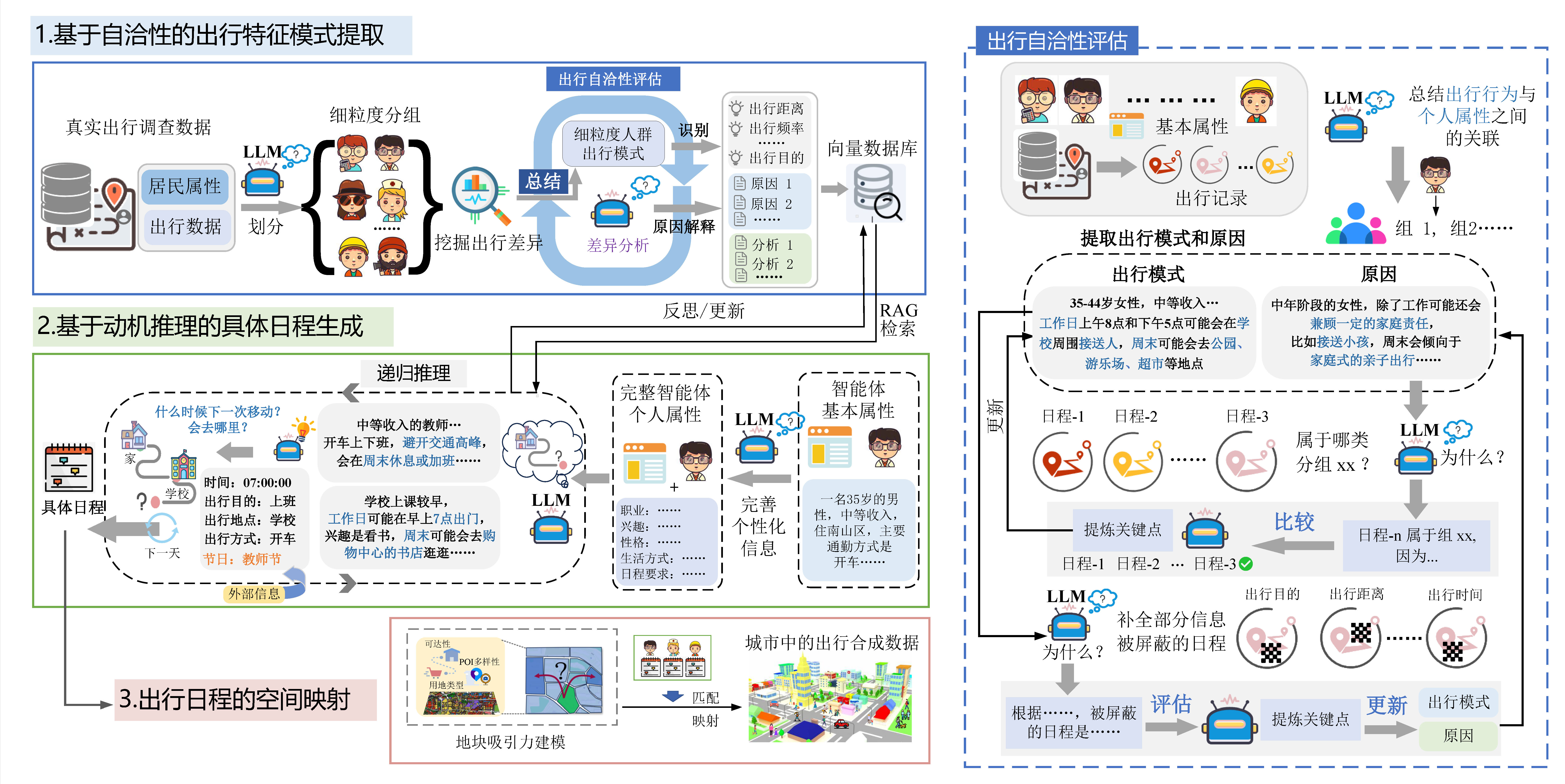
This project leverages Large Language Model Agents (LLM Agents) to generate fine-grained, personalized daily activity and travel diaries for urban residents.
We instantiate a population of LLM Agents within a city, assigning each agent a distinct individual profile—such as age, occupation, income, and household role—along with a specific residential location.
Each agent then plans its daily activity schedule and travel itinerary based on both its individual profile and the surrounding urban environment:
- What time do they leave home in the morning?
- Do they head straight to the office, or drop their children off at school first?
- Where do they go for lunch?
- After work, do they stop by a grocery store, hit the gym, or attend a social gathering on the way?
- Finally, when and by what route do they return home?
Through this approach, we aim to generate data that not only reflects aggregate urban activity patterns, but also captures the behavioral heterogeneity of diverse demographic groups in everyday life—and how these behaviors interact with the physical urban environment.
Open Resources#
To help readers explore, reproduce, and build upon this work, we have open-sourced the project code and a sample of the generated dataset on GitHub.
GitHub Repository
Human Mobility Generation Agent
Related Publications#
Chinese Paper
Huang, F., Xiao, Z., Li, X., Li, G., & Yue, Y. LLM-Agent-Driven Travel Diary Generation Technology (大语言模型智能体驱动的出行日志生成技术)[J]. Geomatics and Information Science of Wuhan University (武汉大学学报·信息科学版). DOI: 10.13203/j.whugis20250277.
English Paper
Li, X., Huang, F., Lv, J., Xiao, Z., Li, G., & Yue, Y. (2024). Be More Real: Travel Diary Generation Using LLM Agents and Individual Profiles. arXiv:2407.18932.
How Can This Data Be Used?#
The dataset released in this project is synthetically generated by models and contains no raw mobility records from real individuals. It can be used to inspect the data structure of the generated outputs, or serve as sample material for travel behavior analysis, urban activity simulation, and downstream model testing.
For instance, researchers can use this data to explore activity patterns across different demographic profiles, analyze the temporal scheduling and spatial distribution of synthetic travel records, or benchmark data processing, visualization, and modeling pipelines.
It is important to note that synthetic data is not a substitute for empirical observational data. Even when generated outputs exhibit realistic aggregate statistical properties, they do not necessarily replicate the exact real-world travel behaviors of a specific city or demographic group.
Therefore, if this data is used for traffic simulation, policy analysis, or urban planning inference, it should always be calibrated and validated against real-world observations and the specific requirements of the target application.